
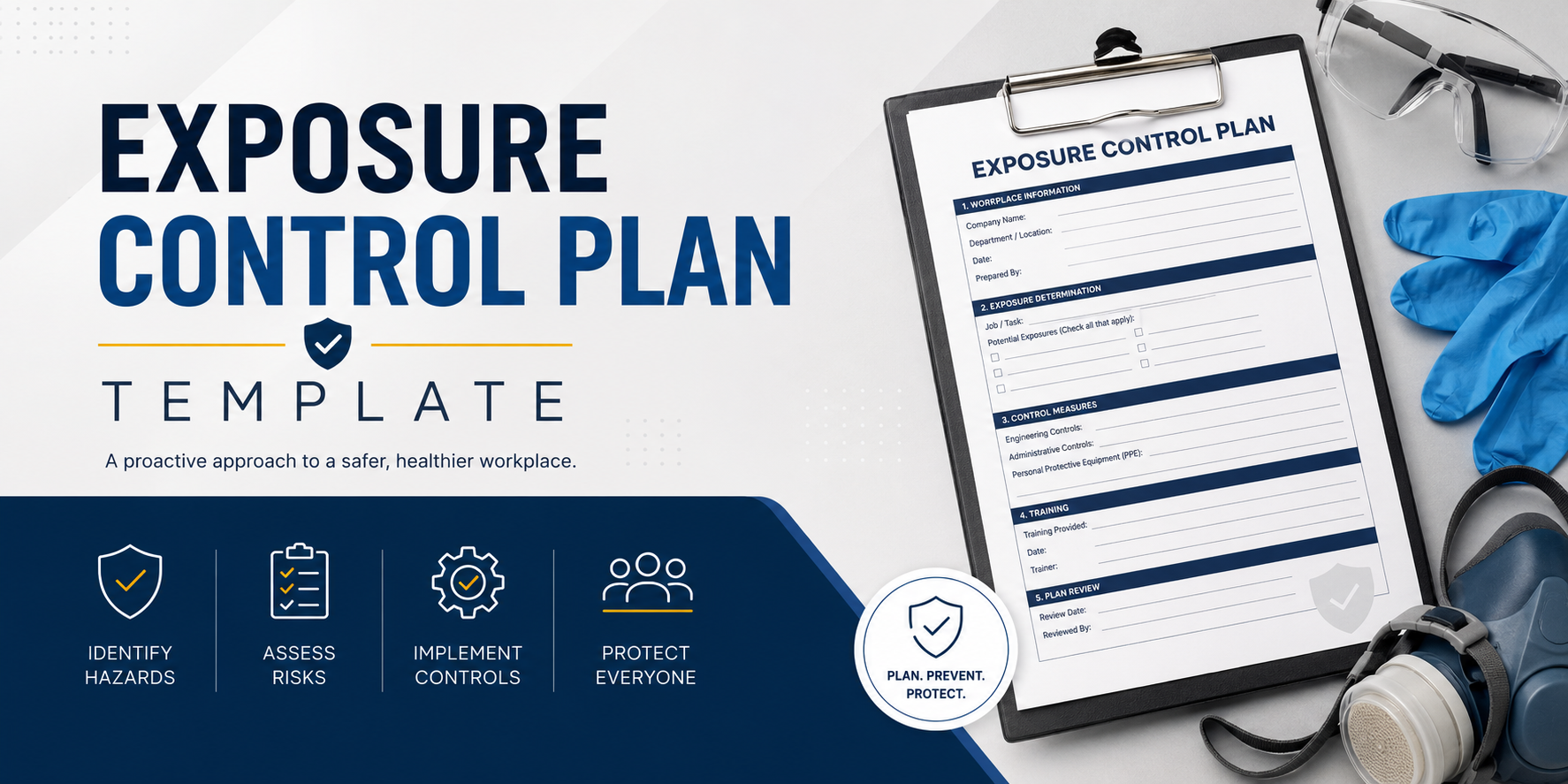
Exposure Control Plan Template:
A Complete Guide for Hazardous Waste Facilities
Everything you need to build, implement, and maintain an OSHA-compliant exposure control plan — including a free downloadable template and expert guidance from Amergy Disposal’s safety professionals.
Key Takeaways
- An exposure control plan (ECP) is legally required under OSHA 29 CFR 1910.1030 for any workplace with bloodborne pathogen or hazardous material risk.
- Your ECP must be reviewed and updated annually — or whenever tasks, procedures, or staffing change.
- The plan must include exposure determination, engineering controls, PPE requirements, training, and post-exposure procedures.
- Facilities that handle medical or chemical waste face additional EPA and state-level requirements beyond OSHA’s baseline.
- Amergy Disposal’s compliance experts can audit, update, or build your ECP from scratch.
Whether you manage a medical waste disposal facility, a clinical laboratory, an outpatient clinic, or an industrial site, a well-structured exposure control plan (ECP) is one of the most critical documents you will ever create. It’s not just a compliance checkbox — it’s the frontline defense between your workers and potentially life-altering occupational hazards.
At Amergy Disposal, we work daily with healthcare providers, research institutions, and industrial facilities to ensure safe, compliant management of hazardous materials. In this comprehensive guide, we’ll walk you through what an exposure control plan is, what it must contain, how to implement it effectively, and what a robust ECP template looks like in practice.
What Is an Exposure Control Plan?
An exposure control plan is a written, facility-specific document mandated by OSHA’s Bloodborne Pathogens Standard (29 CFR 1910.1030). Its primary purpose is to eliminate or minimize employee exposure to bloodborne pathogens — infectious microorganisms found in human blood that can cause serious diseases such as Hepatitis B (HBV), Hepatitis C (HCV), and HIV.
However, for facilities like those working with Amergy Disposal, an ECP extends well beyond bloodborne pathogens. It encompasses:
- Chemotherapy drug residues and pharmaceutical waste
- Sharps and biohazardous waste
- Chemical solvents, reagents, and corrosives
- Radioactive materials (in applicable settings)
- Airborne pathogens and aerosolized hazards
Important: Verbal policies and informal procedures do not satisfy OSHA’s requirements. Your exposure control plan must be in writing, accessible to all employees, and reviewed on a documented schedule.
Who Is Required to Have an Exposure Control Plan?
OSHA requires an exposure control plan for any employer whose workers face occupational exposure — meaning reasonably anticipated skin, eye, mucous membrane, or parenteral contact with blood or other potentially infectious materials (OPIM) during the performance of their duties.
This covers a broader range of industries than most people realize:
| Industry / Sector | Common Exposure Risks | Status |
|---|---|---|
| Hospitals & Clinics | Bloodborne pathogens, needlesticks, aerosols | Required |
| Medical Waste Disposal | Sharps, biohazardous materials, chemical waste | Required |
| Dental Offices | Bloodborne pathogens, aerosols | Required |
| Research Laboratories | Chemical, biological, and radiological agents | Required |
| Emergency Medical Services | Blood, OPIM, trauma-scene exposure | Required |
| Janitorial / Custodial (healthcare) | Contaminated waste, surfaces | Required |
| Tattoo & Body Art Studios | Bloodborne pathogens, sharps | Required |
| Industrial / Chemical Facilities | Chemical exposure, hazardous waste | Recommended + Varies |
Required Elements: What Your ECP Must Include
OSHA specifies exactly what must appear in an exposure control plan. Missing even one required element can result in a citation during inspection. Below is a comprehensive breakdown:
1. Exposure Determination
This section identifies which job classifications and specific tasks put employees at risk of exposure. It must be made without regard to the use of personal protective equipment (PPE) — meaning you document the inherent risk of the task itself, not the mitigated risk.
- List all job titles in which all employees in that classification have occupational exposure (e.g., Phlebotomists, Surgical Technicians)
- List job titles where exposure depends on specific tasks (e.g., Administrative staff who perform occasional first aid)
- For the second category, document the specific tasks that create exposure risk
2. Implementation Schedule and Methodology
This section explains how each element of the OSHA standard will be implemented — essentially your roadmap for turning the written plan into daily practice.
3. Engineering and Work Practice Controls
Engineering controls isolate or remove the bloodborne pathogen hazard from the workplace. Required examples include:
- Sharps disposal containers (closeable, puncture-resistant, leak-proof)
- Self-sheathing needles and needleless systems where feasible
- Biological safety cabinets for handling specimens
- Handwashing facilities or antiseptic hand cleanser where sinks are unavailable
OSHA Update (2001): The Needlestick Safety and Prevention Act requires employers to document their consideration and implementation of safer needle devices in this section, and to involve frontline workers in the evaluation and selection process.
4. Personal Protective Equipment (PPE)
Your ECP must specify which PPE is provided, where it is located, what sizes are available, and how it is cleaned or disposed of. Required PPE categories for bloodborne pathogen exposure include:
- Gloves (latex, nitrile, or vinyl based on task and allergy considerations)
- Gowns, aprons, and lab coats
- Face shields and masks or goggles for splash risk
- Mouthpieces and resuscitation bags for CPR procedures
5. Housekeeping
This section must specify the frequency and method of cleaning and decontaminating equipment, environmental surfaces, and work areas — with particular detail around handling contaminated laundry and regulated waste.
6. Hepatitis B Vaccination Program
Employers must offer the Hepatitis B vaccine series to all employees with occupational exposure — at no cost, at a reasonable time and place, under the supervision of a licensed healthcare professional. The ECP must document this program, including declination procedures.
7. Post-Exposure Evaluation and Follow-Up
When an exposure incident occurs, a specific medical evaluation and follow-up procedure must be in place before the incident happens. This includes the route of exposure documentation, identity of the source individual (if feasible), and the healthcare professional’s written opinion.
8. Communication of Hazards / Training
Labels, signs, and employee training are required at initial assignment and at least annually. Training must be interactive and cover the epidemiology and symptoms of bloodborne diseases, modes of transmission, and proper use of all engineering controls and PPE.
9. Recordkeeping
Medical and training records must be maintained for specific periods — medical records for the duration of employment plus 30 years; training records for 3 years.
Exposure Control Plan Template Checklist
Use the following checklist to build or audit your facility’s ECP. Every item below is required by OSHA 29 CFR 1910.1030 or is a critical best practice for hazardous waste facilities.
- Cover Page & Policy Statement — Facility name, effective date, responsible administrator, and a statement of policy committing to employee protection.
- Exposure Determination — List of all job classifications with occupational exposure, with and without task-specific conditions.
- Engineering Controls Log — Annual review with employee input on safer device selection; list of currently deployed devices.
- Work Practice Controls — Handwashing protocols, specimen handling, decontamination of reusable equipment, no recapping of needles policy.
- PPE Program — Types, locations, sizes, proper use, care, and disposal procedures for all required PPE.
- Housekeeping Schedule — Frequency and method for surface decontamination, waste container handling, and contaminated laundry management.
- Hepatitis B Vaccination Policy — Offer process, documentation of declinations, and post-exposure vaccination records.
- Post-Exposure Incident Protocol — Step-by-step procedure for documenting, reporting, and managing exposure incidents, including source testing consent.
- Hazard Communication & Labeling — Biohazard label requirements, specimen container labeling, and regulated waste container standards.
- Training Program Documentation — Training content outline, trainer qualifications, and employee training log template.
- Recordkeeping Procedures — Medical record maintenance policy (30 years), training record maintenance (3 years), sharps injury log.
- Annual Review Log — Signature page documenting date of review, reviewers, and any changes made.
How to Implement Your Exposure Control Plan
Having a written plan is only the first step. The real challenge — and the one that actually protects your workers — is effective implementation. Here’s the process Amergy Disposal recommends for facilities building or revamping their ECP:
Conduct a Workplace Exposure Assessment
Walk every job function with a safety lens. Identify every task where blood, OPIM, or hazardous chemical contact is possible. Interview frontline workers — they know the real exposure risks better than any org chart.
Identify and Evaluate Engineering Controls
Inventory all current safety devices and controls. Engage workers in evaluating newer, safer alternatives — safety-engineered sharps, needleless IV systems, enclosed transport containers. Document the evaluation process in writing.
Assign Roles and Responsibilities
Designate an ECP Administrator responsible for annual reviews, recordkeeping, and training oversight. Identify department supervisors who will enforce compliance daily. Everyone must know who’s accountable for what.
Draft and Distribute the Written Plan
Write the ECP in plain language accessible to all employees — not just safety officers. Post it in accessible locations or on your intranet. OSHA requires that employees can examine and copy the ECP upon request.
Train All Covered Employees
Conduct initial training before employees begin tasks with occupational exposure risk. Training must be provided during working hours, at no cost to the employee, and must be interactive — employees must be able to ask questions.
Implement a Continuous Review Cycle
Schedule annual reviews on your safety calendar before your ECP anniversary date. Update immediately whenever new procedures, new roles, or new equipment changes exposure risk. Document every review with signatures.
Special Considerations for Medical and Hazardous Waste Facilities
Medical and hazardous waste disposal operations face a uniquely complex regulatory environment. In addition to OSHA’s bloodborne pathogen standard, facilities like those partnering with Amergy Disposal must account for:
- EPA’s Resource Conservation and Recovery Act (RCRA): Governs the handling, storage, and disposal of hazardous waste. Your ECP should align with your RCRA hazardous waste management plan.
- State Medical Waste Regulations: All 50 states have individual regulations that often exceed federal minimums. California, New York, and Florida, for example, have particularly stringent requirements.
- DOT Hazmat Training Requirements: Workers who handle, prepare, or offer hazardous materials for transport need ECP provisions aligned with DOT 49 CFR training mandates.
- NFPA 99 for Healthcare Facilities: Relevant to how waste is managed at the facility level before transfer to a disposal vendor.
Pro Tip: If your facility generates pharmaceutical waste — including RCRA hazardous drugs like warfarin or chemotherapy agents — your ECP should cross-reference your Pharmaceutical Waste Management Plan and specify separate collection, storage, and worker protection protocols for this waste stream. Amergy Disposal provides specialized pharmaceutical waste disposal services that complement a comprehensive ECP.
7 Common Exposure Control Plan Mistakes (and How to Avoid Them)
After auditing hundreds of facilities across the country, Amergy Disposal’s compliance team consistently finds the same critical gaps. Here’s what to watch for:
- Generic, off-the-shelf plans not tailored to your facility. OSHA requires your ECP to be specific to your workplace, your job classifications, and your tasks. A boilerplate template used without customization is likely non-compliant.
- Outdated exposure determination lists. When new roles are added or job duties change, the ECP exposure determination must be updated — not just at the annual review.
- Failure to involve frontline workers in engineering control selection. This is explicitly required under the Needlestick Safety and Prevention Act and is one of the most commonly cited violations.
- Missing or incomplete sharps injury logs. All percutaneous injuries from contaminated sharps must be recorded in a confidential sharps injury log. Many facilities conflate this with the OSHA 300 log, which has different requirements.
- Training records that don’t capture required content. Training logs must document the date, content covered, names and qualifications of the trainer, and names and job titles of all attendees.
- No documented post-exposure incident procedure. The procedure must exist before an incident, not be invented on the spot. Workers must know exactly what to do, who to call, and where to go within minutes of an exposure event.
- Annual review treated as a formality. Simply dating the plan and signing it isn’t sufficient. Reviews should include updated engineering control evaluations, review of any incidents from the past year, and documented input from employees.
Frequently Asked Questions
Partner with Amergy Disposal for Comprehensive Compliance
Building an effective exposure control plan is essential — but it’s only one piece of a comprehensive hazardous waste management program. From medical waste disposal and pharmaceutical waste services to sharps management and regulatory compliance support, Amergy Disposal offers an integrated suite of solutions designed to keep your facility safe, compliant, and audit-ready.
Our compliance specialists can review your existing ECP, help you identify gaps, and ensure your documentation meets both federal and state requirements. We serve healthcare facilities, research institutions, dental practices, veterinary clinics, and industrial sites across the country.