
Medical Waste Regulations by State: The Complete Compliance Guide for Healthcare Facilities
Why State Medical Waste Laws Differ From Federal Standards
At the federal level, the EPA and OSHA set baseline frameworks for handling infectious and hazardous waste — but they delegate primary regulatory authority to individual states. This means your facility’s obligations in California are entirely different from those in Texas, Florida, or New York.
The Medical Waste Tracking Act of 1988 created a temporary federal program, but it expired in 1991. Since then, each state has developed its own statutes, permit requirements, treatment mandates, and manifest systems. For any multi-state healthcare organization, this patchwork creates serious operational risk.
Key variables that differ by state include: the legal definition of regulated medical waste, required generator registration and permit thresholds, approved treatment technologies (autoclave, incineration, chemical), manifest documentation requirements, transporter licensing, and final disposal standards.
What Qualifies as Regulated Medical Waste (RMW)?
While definitions vary, most states recognize the following categories as regulated medical waste requiring specialized disposal:
- Sharps waste — needles, syringes, scalpels, lancets, and broken glass from clinical settings
- Pathological waste — human tissues, organs, body parts, and anatomical specimens
- Microbiological waste — cultures, stocks, and specimens from clinical or research laboratories
- Blood and blood products — liquid blood, serum, plasma, and items saturated with blood
- Isolation waste — waste from patients with highly communicable diseases
- Animal waste — carcasses and bedding from animals exposed to infectious agents (in many states)
- Chemotherapy waste — hazardous drug-contaminated materials (regulated separately as pharmaceutical hazardous waste in some states)
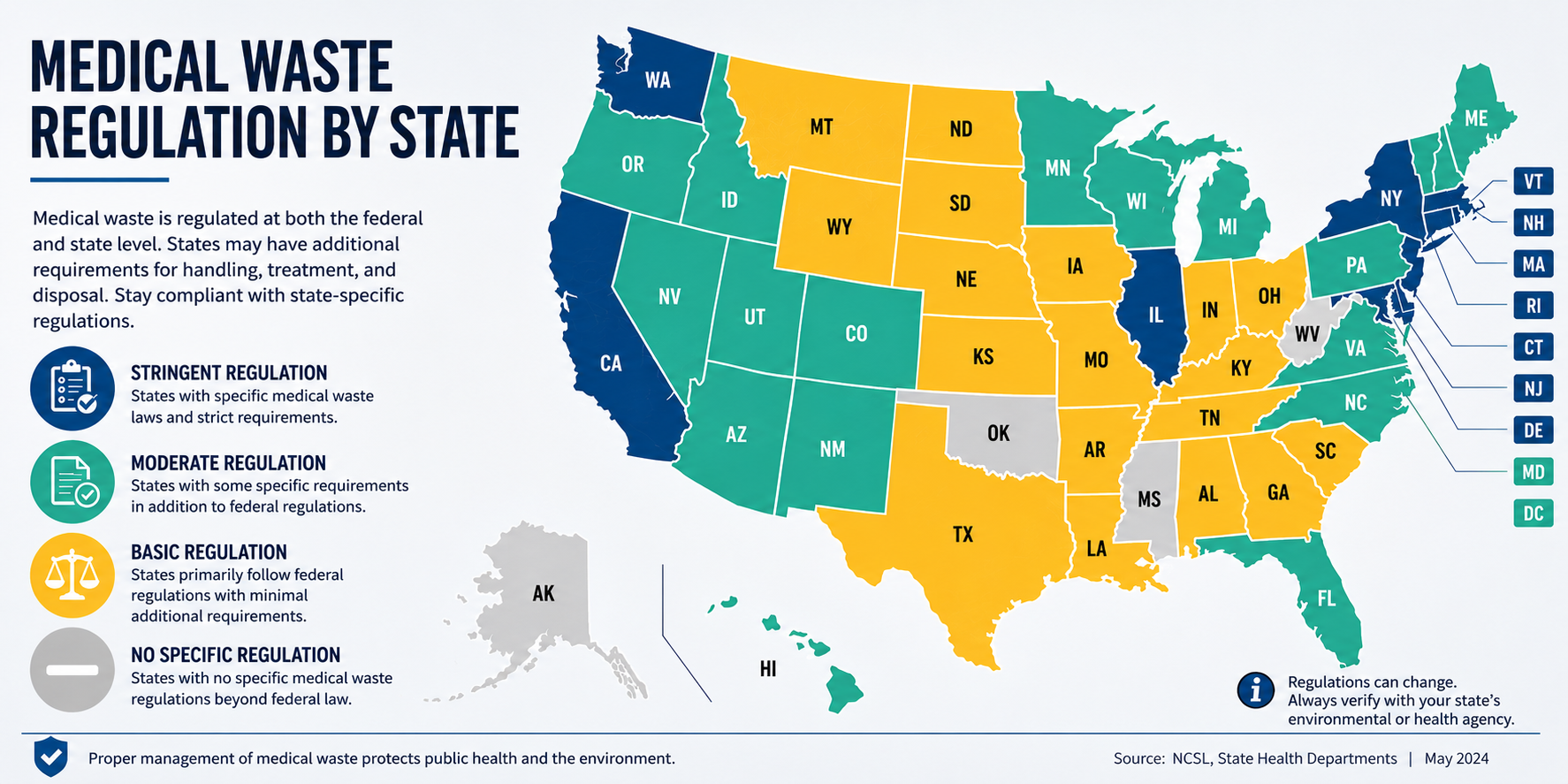
State-by-State Medical Waste Regulation Highlights
Below are highlights for key states across the country. Note that regulations are subject to change — always verify with your state environmental agency or partner with a licensed disposal provider like Amergy Disposal for current compliance guidance.
Highly Regulated States
📍 California
Regulated under CDPH and CalEPA. Generators must register, maintain logs for 3 years, use certified treatment facilities, and comply with strict pharmaceutical waste rules under the Drug Take Back Act. Autoclave validation required annually.
📍 New York
One of the strictest frameworks in the nation. NYSDOH requires on-site treatment logs, transporter permits, and detailed waste tracking manifests. Large generators (>50 lbs/month) face additional reporting obligations.
📍 New Jersey
NJDEP enforces comprehensive generator registration, mandatory manifests, and approval of all disposal methods. The state has one of the broadest definitions of infectious waste in the U.S., capturing many materials other states exempt.
📍 Massachusetts
MassDEP requires licensed haulers and specific treatment technologies. Generators must retain manifests for 3+ years and report any treatment failures. Small quantity generators still face full registration requirements.
📍 Washington
Ecology Department regulations mirror California’s in breadth. Biohazardous waste must be treated before disposal. No self-transport without a hauler permit; tracking documentation is mandatory.
📍 Florida
FDEP rules require transporter registration, specific packaging standards (UN-approved containers), and manifests for all biomedical waste. Sharps disposal rules are especially detailed, addressing retail and home-generated sharps separately.
Moderate Regulatory States
📍 Texas
TCEQ oversees medical waste under Title 30 Texas Administrative Code. Generator registration applies above certain thresholds. Manifests are required for off-site transport, but some small generators may qualify for simplified compliance pathways.
📍 Illinois
IEPA enforces the Medical Waste Act. All generators must use licensed collectors. Infectious waste must be rendered non-infectious prior to landfill disposal. Manifest tracking is required for quantities above 50 lbs/month.
📍 Pennsylvania
DEP regulates infectious and chemotherapeutic waste separately. Generators must register and document all treatment. On-site incineration is heavily restricted; autoclave or off-site disposal is standard practice.
📍 Ohio
Ohio EPA requires licensed infectious waste transporters and mandates generator registration. Manifests must accompany all off-site shipments. Treatment must meet OEPA performance standards — not all autoclaving methods qualify without validation data.
📍 Michigan
EGLE regulates biomedical waste under Part 138 of Michigan’s Natural Resources and Environmental Protection Act. Annual reporting and licensed hauler requirements apply.
📍 Virginia
DEQ enforces medical waste regulations covering both infectious and chemotherapy waste categories. Transporters must be registered. Small-quantity exemptions exist for dental offices and solo physician practices.
Standard Regulatory States
📍 Arizona
ADEQ follows federal baseline standards. Registration requirements are lighter than coastal states, but licensed transporter use is still mandatory. Sharps disposal programs are emphasized given the state’s large home-dialysis and diabetic patient population.
📍 Colorado
CDPHE administers medical waste rules under the Solid Waste Regulations. Infectious waste must be rendered non-infectious before general disposal. Generators above defined thresholds need written waste management plans on file.
📍 Nevada
NDEP rules align closely with federal standards. Off-site transport requires a manifest. Las Vegas metro generators often face additional county-level requirements layered on top of state minimums.
📍 Georgia
EPD regulates biomedical waste under the Georgia Solid Waste Management Act. Facilities generating more than 25 lbs/month must register as generators. Incineration remains more common in Georgia than in many other states.
Compliance Intensity by State: Quick Reference
| State | Regulator | Manifest Required | Generator Registration | Intensity |
|---|---|---|---|---|
| California | CDPH / CalEPA | Yes | Yes — all generators | Strict |
| New York | NYSDOH | Yes | Yes — all generators | Strict |
| New Jersey | NJDEP | Yes | Yes — all generators | Strict |
| Florida | FDEP | Yes | Yes | Strict |
| Washington | Ecology Dept. | Yes | Yes | Strict |
| Massachusetts | MassDEP | Yes | Yes — all generators | Strict |
| Texas | TCEQ | Yes — above threshold | Threshold-based | Moderate |
| Illinois | IEPA | Yes — above 50 lbs/mo | Yes | Moderate |
| Pennsylvania | DEP | Yes | Yes | Moderate |
| Ohio | Ohio EPA | Yes | Yes | Moderate |
| Michigan | EGLE | Yes | Annual reporting | Moderate |
| Virginia | DEQ | Yes | Yes; small-qty exemptions | Moderate |
| Georgia | EPD | Yes — above 25 lbs/mo | Above 25 lbs/mo | Standard |
| Arizona | ADEQ | Yes — off-site transport | Threshold-based | Standard |
| Colorado | CDPHE | Off-site transport | Above threshold | Standard |
| Nevada | NDEP | Yes — off-site | Threshold-based | Standard |
Common Medical Waste Compliance Violations — and How to Avoid Them
Enforcement data from state environmental agencies consistently shows the same categories of violations year after year. Here are the top offenders and what your facility can do to prevent them:
- Using unlicensed transporters. Any vendor moving your regulated medical waste off-site must hold a current state transporter permit. Verify license status before every contract.
- Missing or incomplete manifests. Manifests must accompany all off-site shipments and be retained for the state-required period (2–5 years). Gaps in your manifest trail are among the most cited violations.
- Improper container labeling. State laws specify exact labeling language, biohazard symbols, and generator contact information. Generic or handwritten labels without required identifiers are a common citation.
- Over-filling sharps containers. OSHA and state rules prohibit filling containers above the fill line. Over-filled containers are a leading cause of needlestick injuries and regulatory citations.
- Expired generator registration. Many states require annual renewal of generator permits. Missed renewals place your facility in violation even if all other practices are correct.
- Mixing regulated waste streams. Placing chemotherapy waste with general infectious waste, or pharmaceutical waste with sharps, creates cross-contamination and violates category-specific treatment requirements.
How Amergy Disposal Keeps Your Facility Compliant Nationwide
Medical waste compliance is not a one-time task — it is an ongoing operational responsibility. Amergy Disposal specializes in building turnkey medical waste management programs for healthcare facilities of all sizes, from solo practitioners to multi-site hospital networks.
Our compliance approach is built on four pillars:
State-Licensed Transportation
Our fleet maintains active transporter permits in every state we serve, so your manifests are always clean and defensible.
Compliant Containment Solutions
We provide correctly labeled, UN-approved containers sized to your waste volume, eliminating over-fill and labeling violations.
Digital Manifest Tracking
Our clients receive real-time documentation and long-term secure record storage, delivering audit-ready manifests at any time.
Regulatory Monitoring
Our compliance team tracks state regulatory changes and proactively alerts clients when rules affecting their operations are updated.
Whether your facility operates in a single state or across dozens, Amergy Disposal delivers the expertise, documentation, and logistics to keep you protected.
Is Your Facility Fully Compliant?
Get a free compliance review from Amergy Disposal’s regulatory specialists. We’ll assess your current waste program against your state’s requirements — at no cost.
Request a Free Compliance Review →