
⚠ Texas medical waste generators must use TCEQ-registered transporters — generator liability travels with the waste until final treatment. Is your hauler TCEQ-registered? Get a free Amergy compliance check →
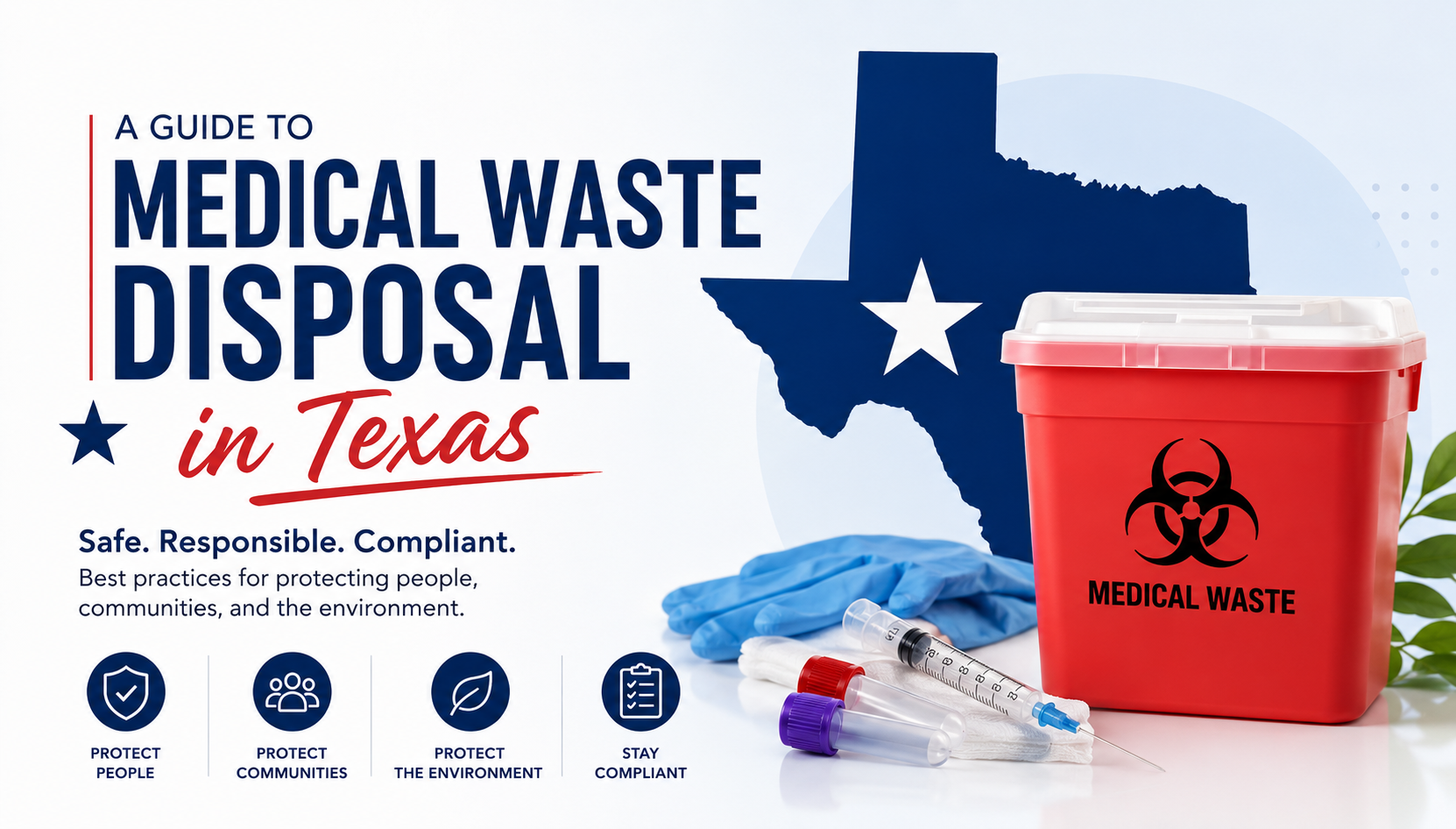
Texas Medical Waste Disposal: Two Agencies, One Standard, Zero Shortcuts
Texas is the only state in the nation where medical waste compliance is jointly enforced by two separate state agencies — the TCEQ and the DSHS. Here’s everything your Lone Star State business needs to know, and how Amergy Disposal makes compliance simple across all 254 Texas counties.
Texas Medical Waste Disposal: The Dual-Agency Framework Every Generator Must Understand
The Lone Star State’s Unique Compliance Structure
When it comes to Texas medical waste disposal, the very first thing every generator must understand is that Texas operates under a uniquely complex, dual-agency regulatory structure found in no other state. Specifically, medical waste compliance in Texas is jointly governed by the Texas Commission on Environmental Quality (TCEQ) — which oversees treatment, transport, and disposal through 30 TAC Chapter 326 — and the Texas Department of State Health Services (DSHS), which regulates “special waste from health care-related facilities” under 25 TAC Chapter 1, Subchapter K (Sections 1.131–1.137). Together, these two agencies create a compliance landscape that simultaneously exceeds federal EPA and OSHA baselines. Consequently, businesses that rely solely on federal guidance — or that assume Texas mirrors neighboring states — routinely discover compliance gaps at the worst possible time.
Moreover, Texas is the second most populous state in the nation with over 31 million residents and one of the fastest-growing healthcare markets in the country. As a result, the volume of medical waste generated annually — and the stakes of improper disposal — are enormous. Amergy Disposal specializes in navigating Texas’ dual-agency framework for businesses across all 254 Texas counties.
Who This Guide Is Written For
This comprehensive guide is written for any business generating medical waste in Texas and any business that generates, stores, transports, treats, or disposes of medical waste in the Lone Star State. That includes hospitals, dental offices, urgent care centers, veterinary clinics, research laboratories, dialysis centers, pharmacies, tattoo studios, acupuncture clinics, nursing homes, and funeral homes. Furthermore, this guide covers the TCEQ and DSHS rules your facility must follow, the financial penalties for non-compliance, and how Amergy Disposal reduces both cost and compliance risk simultaneously.
⭐ Texas-Specific Focus
Throughout this guide, our focus keyphrase is Texas medical waste disposal. The state’s dual-agency model — TCEQ + DSHS — makes Texas unlike any other state in the nation. Understanding both agencies is essential to full compliance.
How Texas Defines Medical Waste — And Why It’s Broader Than You Think
Texas’ Dual Definition Framework
Texas uses two overlapping but distinct definitions of medical waste, and understanding both is essential to full TCEQ and DSHS compliance in Texas. Under 30 TAC 326.3(23), TCEQ defines medical waste as treated and untreated special waste from health care-related facilities — including any regulated medical waste as defined under federal DOT regulations (49 CFR 173.134(a)(5)). Additionally, DSHS separately defines “special waste from health care-related facilities” under 25 TAC 1.132 as five specific categories of waste that require special handling regardless of whether they meet the broader medical waste threshold.
DSHS’ Five Special Waste Categories
Specifically, DSHS recognizes the following five categories of special waste from health care-related facilities:
- Animal waste — waste from animals intentionally exposed to pathogens in research settings
- Bulk blood and blood products — containerized volumes of 100 mL or more of blood, blood products, or bodily fluids
- Microbiological waste — cultures, stocks, and specimens of infectious agents from laboratories
- Pathological waste — human recognizable anatomical parts, tissues, and organs
- Sharps — needles, syringes, blades, and any items capable of causing punctures or cuts
Small vs. Large Generator Status
Additionally, Texas uses a volume-based generator classification. Notably, a medical waste generator producing 50 pounds or less per month is classified as a small quantity generator with simplified but still real compliance obligations. By contrast, facilities generating more than 50 pounds per month face full TCEQ registration, manifest, and transportation requirements. Consequently, knowing your monthly volume — and tracking it accurately — directly determines the scope of your compliance program. When in doubt, Amergy offers a free Texas-specific compliance assessment.
⚡ Texas-Specific Insight
Texas is one of the few states where bulk blood and blood products are defined by a specific volumetric standard (100 mL or more). This means that non-bulk blood items — such as blood-soaked gauze — may be handled differently than bulk blood containers, creating a distinction that often surprises healthcare providers new to Texas medical waste disposal compliance.
Texas Medical Waste Laws: A Plain-English Breakdown of TCEQ & DSHS Rules
The Governing Statutes
All medical waste activity in Texas is governed by two parallel regulatory frameworks. The TCEQ’s rules are found in 30 TAC Chapter 326 (Medical Waste Management) and 30 TAC Chapter 330 (Municipal Solid Waste). The DSHS rules are in 25 TAC Chapter 1, Subchapter K. Furthermore, the federal standards of OSHA (29 CFR 1910.1030), DOT/PHMSA, and EPA RCRA all apply alongside state rules — and generators must comply with all layers simultaneously. As a result, compliance in Texas carries a multi-layered obligation that requires careful, ongoing management.
Cradle-to-Grave Tracking: Texas’ Core Compliance Mandate
TCEQ mandates cradle-to-grave tracking for all medical waste generated in Texas. Every off-site shipment requires a manifest document accompanying the waste from generator to final treatment facility. Facilities must register with TCEQ and adhere to its comprehensive guidelines for proper containment, transportation, treatment, and disposal. Treated medical waste may be sent to a permitted MSW Type I landfill, provided a shipping document — including a statement that the waste has been treated — accompanies the shipment per 30 TAC 326.75(r). The TCEQ application fee for a medical waste registration is $150, with no fee for a notification filing.
DSHS Treatment, Handling & Disposition Requirements
In parallel with TCEQ’s transport and disposal rules, DSHS under 25 TAC Chapter 1, Subchapter K regulates the treatment and on-site handling of special waste from health care-related facilities. Specifically, DSHS mandates approved treatment methods — including incineration, autoclaving, and chemical treatment — that must render medical waste non-infectious prior to disposal. Additionally, any generator treating medical waste on-site must file a notification with TCEQ’s Waste Permits Division using Form TCEQ-20788. Furthermore, sharps waste documentation must follow guidelines under 25 TAC §1.136 and §326.23(e) for shipments of treated sharps or sharps residuals to solid waste landfills.
How Texas Requires Medical Waste to Be Contained
Medical waste in Texas must be separated from other waste at the point of generation. Containers must be rigid, leak-proof, and puncture-resistant, and must bear the international biohazard symbol and be clearly labeled “Biohazardous Waste.” Storage areas must be clearly marked with warning signs, secured against unauthorized access, and maintained to prevent any potential release of contaminants. Additionally, medical waste must be treated at an authorized treatment facility prior to transport to a permitted MSW landfill — untreated medical waste cannot go directly to a landfill under any circumstances in Texas.
Additional Texas-Specific Compliance Requirements
- TCEQ-Registered Transporters Only: All medical waste transportation in Texas must be performed by TCEQ-registered transporters. Using an unregistered hauler exposes your facility to full generator liability for the waste from point of pickup through final treatment — regardless of any contract with the transporter.
- On-Site Treatment Notification (Form TCEQ-20788): Generators wishing to treat waste on-site must submit a notification to TCEQ’s Waste Permits Division using Form TCEQ-20788 prior to beginning treatment operations. This notification is required even for autoclaves and other standard technologies.
- Sharps Documentation (25 TAC §1.136): Treated sharps destined for landfill disposal must be accompanied by written statements verifying treatment by an approved method. These documentation requirements apply to all healthcare facilities, including small generators.
- Record-Keeping Requirements: Texas law requires accurate, ongoing documentation of waste generation, transport, and disposal. Specifically, records must be maintained and available for TCEQ inspection at any time. Both TCEQ and DSHS may independently request and review your records.
- Household Syringe Disposal: Unlike most states, TCEQ publishes a specific guidance document for household syringe disposal — reflecting the scale of home health care waste generation across Texas’ vast geography.
- Pharmaceutical Waste: Pharmaceutical waste that meets RCRA hazardous waste definitions is separately regulated under federal EPA and Texas state rules. Flushing medications or placing them in regular trash is prohibited. Non-RCRA pharmaceuticals must follow DSHS disposal guidance.
- Employee Training: All personnel handling medical waste must receive documented OSHA Bloodborne Pathogen training (29 CFR 1910.1030) before initial exposure, with annual refresher training. Training records must be maintained on-site and available for inspection.
- Texas Medical Center Complex: Generators located within the Texas Medical Center in Houston — the world’s largest medical complex — face unique, high-volume waste management challenges that require specially optimized service schedules and documentation systems.
⚠ Top TCEQ & DSHS Violations in Texas
Inspectors most frequently cite Texas businesses for: (1) using unregistered transporters, (2) missing or incomplete manifest documents, (3) improper labeling or segregation, and (4) inadequate record-keeping. Let Amergy review your Texas medical waste disposal program for free →
TCEQ’s Mission & How Amergy Keeps Your Business Aligned
The TCEQ’s Role in Texas
The Texas Commission on Environmental Quality (TCEQ) is the primary environmental regulatory agency in Texas and the lead authority for medical waste enforcement in the state. As the largest state environmental agency in the country, TCEQ operates from its Austin headquarters and through 16 regional offices spread across the state — ensuring enforcement reaches even the most remote Texas communities, from the Panhandle to the Rio Grande Valley.
📋 Official TCEQ Mission Statement
“The Texas Commission on Environmental Quality strives to protect our state’s public health and natural resources consistent with sustainable economic development. Our goal is clean air, clean water, and the safe management of waste.”
DSHS’ Parallel Role
Equally important, the Texas Department of State Health Services (DSHS) administers the treatment and handling standards for special waste from health care-related facilities under 25 TAC Chapter 1. As a result, generators must ensure compliance with both agencies’ requirements simultaneously. DSHS has the authority to inspect healthcare facilities independently from TCEQ — meaning your facility can receive visits from two separate enforcement agencies, each reviewing different aspects of your Texas medical waste disposal program.
How Amergy Supports Both Agencies’ Missions
- TCEQ-Registered Haulers at Every Stop: Every Amergy pickup in Texas uses TCEQ-registered transporters, providing cradle-to-grave accountability for every waste stream your facility generates.
- Compliant Manifests for Every Shipment: Amergy generates fully compliant TCEQ manifest documentation for every pickup — stored in your compliance portal for the full retention period and instantly accessible during TCEQ or DSHS inspections.
- DSHS-Aligned Treatment Verification: Amergy delivers all Texas medical waste to TCEQ-authorized and DSHS-approved treatment facilities, ensuring every pound of waste is rendered non-infectious before landfill disposal — exactly as both agencies require.
- Economic Development Alignment: Consistent with TCEQ’s goal of sustainable economic development, Amergy’s transparent all-inclusive pricing keeps compliance affordable — freeing resources for patient care, research, and business growth.
The Real Cost of Texas Medical Waste Disposal Non-Compliance
Penalties From Two Agencies — Simultaneously
Because Texas uses a dual-agency enforcement model, non-compliant generators face a uniquely dangerous exposure: they can receive enforcement actions from both TCEQ and DSHS simultaneously, for different but overlapping aspects of the same waste stream. Under the Texas Health & Safety Code §361.085 and TCEQ’s civil penalty authority, fines for medical waste violations in Texas can exceed $50,000 per incident. Furthermore, RCRA-related violations for pharmaceutical or hazardous waste carry separate federal maximum penalties exceeding $93,000 per violation per day. As a result, a single compliance failure can generate liability from three separate enforcement authorities simultaneously.
TCEQ civil penalties per incident for improper Texas medical waste disposal under Texas Health & Safety Code §361.085.
Federal maximum RCRA penalty per violation per day for pharmaceutical/hazardous waste violations (January 2025, subject to annual increases).
TCEQ and DSHS can initiate separate, concurrent enforcement proceedings — exposing generators to fines and sanctions from two agencies at once.
Knowing or willful violations of Texas medical waste rules may result in criminal prosecution, misdemeanor or felony charges, and imprisonment.
TCEQ may revoke a transporter’s registration or a facility’s medical waste authorization, halting all operations immediately.
Generators bear full, uncapped personal liability for all remediation costs from improperly disposed or abandoned medical waste anywhere in Texas.
✓ Prevention Costs Far Less Than Any Penalty
A full year of compliant Texas medical waste disposal service with Amergy costs a fraction of a single TCEQ civil penalty. Get your free quote and compliance assessment from Amergy today →
How Texas Businesses Are Reducing Their Medical Waste Disposal Costs
Why Most Texas Businesses Overpay
From the Texas Medical Center in Houston to hospital networks in Dallas-Fort Worth and research facilities in Austin, Texas businesses routinely discover that their current biohazardous waste vendor is overcharging them. Hidden fuel surcharges, environmental fees, overweight penalties, and automatically renewing contracts with annual price escalations are widespread across the national vendors operating in Texas. By contrast, Amergy offers transparent all-inclusive pricing — covering TCEQ-registered pickup, manifest documentation, compliance portal access, and DSHS-aligned treatment verification — in a single flat rate with no hidden fees.
Estimated Monthly Savings by Business Type
Below are the estimated monthly savings that Texas businesses achieve after switching to Amergy Disposal. Figures are based on industry averages for each business type across comparable Texas waste volumes.
| # | Texas Business Type | Primary Waste Streams | Typical Monthly (Before) | With Amergy | Monthly Savings |
|---|---|---|---|---|---|
| 01 | 🏥 Hospitals & Health Systems | Biohazardous, sharps, chemo, pathology, pharma | $9,000–$18,000 | $5,700–$11,500 | $3,300–$6,500/mo |
| 02 | 🫚 Dialysis Centers | High-volume biohazardous, sharps, tubing | $2,500–$5,200 | $1,400–$3,000 | $1,100–$2,200/mo |
| 03 | 🧓 Skilled Nursing & Long-Term Care | Sharps, biohazardous, pharmaceutical, pathology | $1,300–$3,200 | $720–$1,850 | $580–$1,350/mo |
| 04 | 💉 Urgent Care & Walk-In Clinics | Sharps, biohazardous, pharmaceutical | $580–$1,300 | $310–$730 | $270–$570/mo |
| 05 | 🔬 Clinical & Research Laboratories | Cultures, biohazardous, sharps, chemical waste | $1,900–$4,800 | $1,050–$2,750 | $850–$2,050/mo |
| 06 | 🦷 Dental Practices | Sharps, amalgam, biohazardous, pharmaceutical | $350–$720 | $180–$400 | $170–$320/mo |
| 07 | 🐾 Veterinary Clinics | Sharps, pharmaceutical, biohazardous, pathology | $375–$840 | $200–$460 | $175–$380/mo |
| 08 | 🎨 Tattoo & Body Art Studios | Sharps, biohazardous (explicitly regulated in TX) | $165–$340 | $82–$180 | $83–$160/mo |
| 09 | 💊 Pharmacies & Compounding Pharmacies | Pharmaceutical waste, sharps, trace chemo | $560–$1,200 | $290–$670 | $270–$530/mo |
| 10 | 🏠 Home Health Agencies | Sharps consolidation, biohazardous, pharmaceutical | $450–$1,000 | $240–$565 | $210–$435/mo |
💡 Get Your Custom Texas Savings Estimate
Savings vary based on waste volume, pickup frequency, and current vendor terms. Contact Amergy for a free, no-obligation Texas-specific savings analysis →
Amergy Delivers Texas Medical Waste Disposal Across All 254 Counties
Every County in the Lone Star State — Covered
⭐ All 254 Texas Counties Served
Amergy Disposal provides TCEQ-registered pickup, compliant manifest documentation, DSHS-aligned treatment verification, and a full online compliance portal to businesses across every one of Texas’ 254 counties. Whether your facility is in downtown Houston, the Dallas Medical District, Austin’s research corridors, San Antonio’s South Texas Medical Center, rural West Texas, or the Rio Grande Valley — Amergy delivers the same high-standard, fully compliant biohazardous waste disposal service at every stop.
Texas’ 20 Most Populous Cities We Actively Serve
The cities below represent the core of Amergy’s active Texas service network. Nevertheless, our reach extends far beyond these urban centers. Community health clinics in Laredo, veterinary practices in Abilene, dialysis centers in Midland, and dental offices in Beaumont are just as central to our statewide mission as the massive health systems in Houston and Dallas.
📍 Not Listed? We Still Serve You.
Amergy provides service throughout all 254 Texas counties and all 1,795+ Texas municipalities. From Brewster County in far West Texas to Jefferson County on the Gulf Coast — if your business generates medical waste anywhere in Texas, Amergy has a Texas medical waste disposal solution for you →
Your 24/7 Texas Medical Waste Compliance Portal — Free With Every Account
Why Documentation Is Your Greatest Defense in Texas
Because proper compliance in Texas requires TCEQ manifest documentation for every pickup, records available for inspection by two separate agencies, documented employee training, and TCEQ-registered transporter verification — staying organized is legally required. Fortunately, every Amergy Texas customer receives full access to our Online Safety Compliance Portal at no additional charge. This purpose-built dashboard puts your entire TCEQ and DSHS compliance program at your fingertips, 24 hours a day, from any device.
Built for Texas’ Dual-Agency Requirements
Unlike generic compliance tools, Amergy’s portal is configured specifically around Texas’ dual-agency regulatory structure. As a direct result, it captures the documentation both TCEQ and DSHS reviewers look for during unannounced inspections. Additionally, the portal automatically tracks TCEQ transporter registration expiration dates — alerting you before a hauler’s registration lapses — so your compliance chain is never broken by an administrative oversight.
What’s Inside Your Amergy Texas Compliance Portal
- TCEQ manifest generation & tracking for every TX pickup
- DSHS treatment verification documentation per 25 TAC Ch. 1
- TCEQ transporter registration verification & expiry alerts
- On-site treatment notification tracking (Form TCEQ-20788)
- OSHA bloodborne pathogen training modules & certificates
- Annual training renewal reminders by employee name
- Pickup calendar with TCEQ-compliant confirmation records
- Waste volume analytics & monthly cost breakdown reports
- Instant inspection-ready compliance summary export
- Small vs. large generator status tracking (≤50 lbs threshold)
- Multi-site dashboard for larger Texas health systems
- Direct access to your dedicated Texas compliance specialist
8 Surprising Facts About Texas Medical Waste Disposal
Texas’ approach to medical waste regulation is shaped by the state’s extraordinary scale, its position as a global healthcare hub, and its uniquely complex dual-agency enforcement structure. Here, therefore, are eight facts that reveal just how distinctive medical waste compliance truly is in the Lone Star State.
The World’s Largest Medical Complex
Houston’s Texas Medical Center is the world’s largest medical complex, encompassing over 60 institutions and generating an estimated 10,000+ pounds of biohazardous waste per hospital per year. As a direct result, Houston alone represents one of the highest-density medical waste generation zones in the entire country — making optimized, compliant service routes absolutely essential.
Two Agencies, One Waste Stream
Texas is the only U.S. state with a formalized dual-agency enforcement model for medical waste — TCEQ and DSHS operating under separate statutory frameworks over the same waste streams. Consequently, a single compliance failure in Texas can trigger simultaneous enforcement from two independent state agencies, a risk that exists nowhere else in the nation.
254 Counties: More Than Any Other State
Texas has 254 counties — more than any other state in the nation. Moreover, many of these counties are larger in geographic area than multiple other U.S. states combined. As a result, service route optimization for Texas medical waste disposal is uniquely complex, and generators in rural areas must verify hauler coverage and TCEQ registration status before every contract.
Texas Is Growing Faster Than Any State
Texas added more new residents than any other state between July 2023 and July 2024 — an estimated 562,941 people in a single year. As a direct consequence, new hospitals, urgent care centers, dental offices, and specialty clinics open across Texas every month, rapidly expanding the population of medical waste generators subject to TCEQ and DSHS compliance requirements.
The 100 mL Bulk Blood Standard
Texas DSHS is one of the few state agencies in the nation that defines bulk blood and blood products by a specific volumetric threshold — 100 mL or more. This means that non-bulk blood items (such as blood-soaked gauze) are handled differently from bulk containers, creating a compliance distinction that surprises many healthcare providers new to Texas and its specific regulatory framework under TCEQ and DSHS.
TCEQ Is the Largest State Environmental Agency in the U.S.
TCEQ operates 16 regional offices across Texas, making it the largest state environmental agency in the country by geographic coverage. Furthermore, TCEQ maintains a dedicated small business assistance hotline and a public-facing permitting inquiry line — reflecting the agency’s recognition that compliance support is as important as enforcement for sustaining Texas’ business-friendly environment.
On-Site Treatment Requires a Federal Filing
Unlike most states that require only state-level notification for on-site medical waste treatment, Texas generators using autoclaves or other on-site technologies must file Form TCEQ-20788 with the TCEQ Waste Permits Division. This additional step is one of the most commonly missed compliance requirements for facilities attempting to manage their waste internally, and a frequent source of TCEQ citation during inspections.
The $150 Registration Fee That Saves Thousands
TCEQ charges a $150 application fee for a medical waste registration — one of the most modest state registration fees in the country. In contrast, the civil penalties for operating without proper registration can exceed $50,000 per incident. As a result, the cost-to-benefit ratio of maintaining proper TCEQ registration in Texas is among the most compelling of any TCEQ registration requirement in the Lone Star State.
Texas Regulatory & Business Contacts Every Generator Should Have
Staying on top of TCEQ and DSHS compliance starts with knowing exactly who to call. Below, therefore, are the primary TCEQ, DSHS, and business support contacts every Texas generator should have readily accessible.
TCEQ — Medical Waste (Austin HQ)
Texas Commission on Environmental Quality
(512) 239-1000 (800) 447-2827 (Small Biz Assist)12100 Park 35 Circle, Austin, TX 78753
tceq.texas.gov · Mon–Fri 8am–5pm CT
TCEQ — 24-Hour Emergency
TCEQ Environmental Emergency Line
(800) 832-822424/7 · Report spills, medical waste abandonment & all environmental emergencies anywhere in Texas
Texas DSHS — Special Waste
Texas Dept. of State Health Services
(512) 776-71111100 W. 49th Street, Austin, TX 78756
dshs.texas.gov · Special waste from health care-related facilities
TCEQ Permitting Inquiries
TCEQ Public Participation Line
(800) 687-4040Medical waste registration, permits & permitting process questions · 8am–5pm CT business days
Business Support
Texas Association of Business (TAB)
(512) 477-67211209 Nueces Street, Austin, TX 78701
texasbusiness.org · Business compliance resources & advocacy
Your Texas Compliance Partner
Amergy Disposal — Texas Team
amergydisposal.com/contactFree quotes · Free TCEQ/DSHS compliance reviews
All 254 TX counties · TCEQ-registered haulers
Compliance portal included with every account
Ready to Simplify Texas Medical Waste Disposal for Your Business?
From Houston to Dallas to El Paso — Texas businesses trust Amergy Disposal for transparent all-inclusive pricing, TCEQ-registered haulers, dual-agency compliance documentation, and a portal that keeps every record inspection-ready across all 254 counties. Get your free quote today.
Get My Free TX Quote at amergydisposal.com →Texas Medical Waste Disposal Compliance: Simpler With the Right Partner
What We’ve Covered
To summarize: Texas medical waste disposal compliance operates under a uniquely complex dual-agency framework — TCEQ administering transport and disposal through 30 TAC Chapter 326, while DSHS governs treatment and handling through 25 TAC Chapter 1. The 50-pound small generator threshold, the cradle-to-grave manifest mandate, the TCEQ-registered hauler requirement, the on-site treatment notification form, and the Texas Medical Center’s extraordinary waste volumes all set Texas apart from every other state in the nation.
The Case for a Proven Partner
Nevertheless, navigating both agencies’ requirements simultaneously does not have to be complicated, time-consuming, or expensive. In fact, businesses that partner with Amergy Disposal consistently find that their compliance program becomes more organized and their costs decrease at the same time. That is because Amergy’s all-inclusive pricing eliminates hidden fees, while the 24/7 compliance portal handles manifest documentation, transporter verification, DSHS treatment records, and employee training documentation automatically.
Take Action Today
Ultimately, the Texas businesses that manage Texas medical waste disposal most effectively are not those who have memorized every provision of 30 TAC Chapter 326 and 25 TAC Chapter 1. Rather, they are the ones who have chosen a partner that already knows both frameworks — and ensures they never have to worry about either one. That partner is Amergy Disposal. Getting started takes less than five minutes.
✓ Get Started in Minutes
Visit amergydisposal.com/contact for your free Texas medical waste disposal compliance assessment and pricing quote. All-inclusive transparent pricing, no long-term contracts required, TCEQ-registered haulers, and a 24/7 compliance portal — included with every Amergy account, statewide across all 254 Texas counties.