
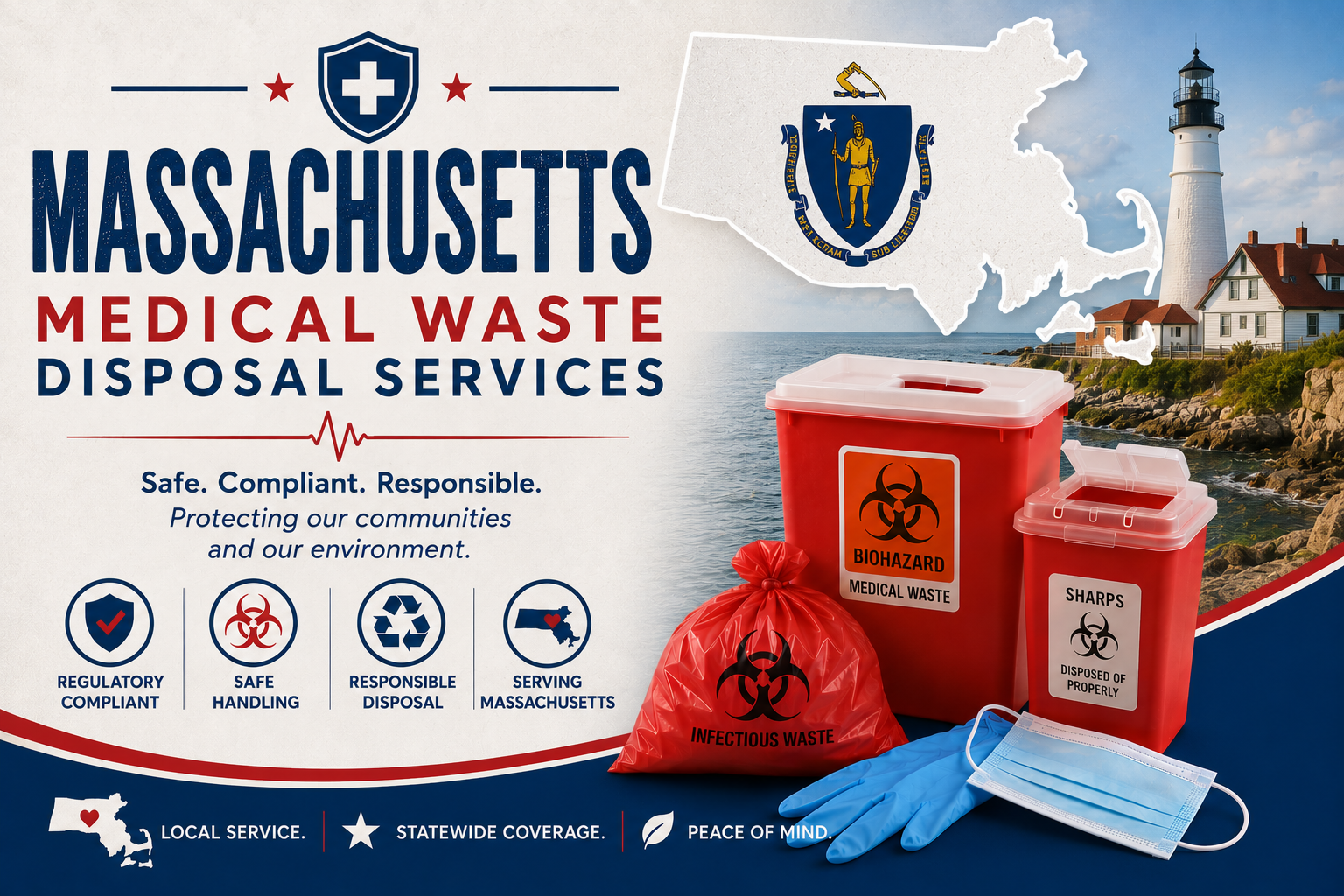
Massachusetts Medical Waste Disposal, Made Simple and More Affordable
Across the Bay State, healthcare facilities are cutting compliance costs and eliminating disposal headaches. Here is how proper Massachusetts medical waste disposal keeps your practice DPH-compliant while saving thousands every year.
Massachusetts medical waste disposal is more than a routine pickup — instead, it is a legal obligation that protects your staff, your patients, and the communities from Boston Harbor to the Berkshires. From a busy Worcester hospital to a small-town dental office on Cape Cod, every generator of regulated waste in Massachusetts must follow specific handling, storage, and transport rules. Consequently, choosing the right disposal partner is one of the smartest financial and compliance decisions a Massachusetts facility can make. Moreover, Amergy Disposal helps hundreds of businesses stay compliant while trimming costs that legacy haulers quietly inflate year after year.
In this guide, therefore, we break down exactly what Massachusetts requires, how much you could save, and where Amergy is already helping facilities across the Commonwealth. Additionally, we include the local agency phone numbers, state-specific requirements, and a few fun facts you probably did not know about waste in Massachusetts.
The Bottom LineHow Massachusetts Businesses Are Saving Thousands
Medical waste contracts are notorious for hidden fees. Specifically, legacy vendors bury automatic price increases, fuel surcharges, environmental fees, and long-term auto-renewal clauses inside the fine print. As a result, a facility that signed at a fair rate five years ago may now be overpaying by 30% to 50% without ever agreeing to it.
Amergy, in contrast, takes the opposite approach. Notably, we offer transparent, flat-rate pricing with no surprise surcharges and no punishing multi-year lock-ins. Therefore, Massachusetts facilities that switch typically see immediate, measurable savings. In fact, many practices recover thousands of dollars annually simply by right-sizing pickup frequency and eliminating the “phantom fees” their old hauler was charging.
10 Massachusetts Businesses That Generate the Most Medical Waste
Not every facility produces the same volume of regulated waste. Notably, the ten business types below generate the highest volumes across Massachusetts; as a result, they have the most to gain from smarter Massachusetts medical waste disposal. Meanwhile, the estimated monthly savings reflect typical reductions when switching from a legacy national hauler to Amergy.
| Business Type | Why Volume Is High | Est. Monthly Savings |
|---|---|---|
| Hospitals & Health Systems | 24/7 surgical, ER, and inpatient waste streams | $800 – $2,400 |
| Academic Medical & Research Centers | Dense teaching-hospital and lab corridor | $500 – $1,500 |
| Surgical & Ambulatory Centers | High sharps and single-use instrument volume | $450 – $1,300 |
| Dialysis Clinics | Bloodlines, filters, and daily treatment waste | $400 – $1,100 |
| Dental Practices | Extracted teeth, sharps, and infectious materials | $150 – $600 |
| Long-Term Care & Nursing Homes | Continuous resident care and sharps | $300 – $900 |
| Physician & Urgent Care Clinics | High patient throughput, vaccines, sharps | $200 – $700 |
| Clinical & Biotech Laboratories | Cultures, stocks, and pathological waste | $350 – $1,000 |
| Veterinary Hospitals | Animal-care infectious and sharps waste | $180 – $650 |
| Pharmacies & Compounding Centers | Expired and hazardous pharmaceutical waste | $150 – $550 |
Estimates are illustrative and vary by facility size, pickup frequency, and current contract terms. Request a free quote for figures specific to your operation.
The RulesMassachusetts Medical Waste Laws & Regulations
Massachusetts medical waste disposal is regulated primarily by the Massachusetts Department of Public Health (DPH), with the Department of Environmental Protection (MassDEP) also involved in transport and disposal oversight. Furthermore, facilities must also comply with federal OSHA Bloodborne Pathogens and U.S. DOT transport standards. Consequently, understanding how these layers fit together is essential to staying compliant.
The Governing Rule: 105 CMR 480.000
Massachusetts’ medical waste rules live in 105 CMR 480.000, known as State Sanitary Code Chapter VIII. Specifically, this single chapter sets the minimum requirements for the storage, treatment, disposal, and transportation of what the Commonwealth calls “medical or biological waste.”
How Massachusetts Defines Medical or Biological Waste
Under Massachusetts rules, medical or biological waste includes blood and blood products, pathological waste, contaminated animal waste, cultures and stocks of infectious agents, and sharps. Notably, the Commonwealth defines sharps broadly — beyond needles, it captures syringes, pipettes, scalpel blades, dental wires, and even disposable razors used in a medical procedure.
Key Massachusetts Regulatory References
- 105 CMR 480.000 — the core medical or biological waste chapter (State Sanitary Code Chapter VIII).
- 105 CMR 480.300 — the Massachusetts packaging, labeling, and shipping standards.
- OSHA 29 CFR 1910.1030 — the federal Bloodborne Pathogens Standard governing red-bag handling.
- 49 CFR 173.196–173.197 — federal DOT packaging rules for regulated medical waste in transport.
Medical Waste Requirements Unique to Massachusetts
While much of medical waste regulation is federal, Massachusetts layers on several state-specific requirements that facilities must know. Consequently, a compliance program built for another state will not automatically satisfy the DPH.
Distinct Packaging: 3-Mil Bags and Rigid Containers
Massachusetts requires waste bags of three-mil or greater polyethylene (or equivalent). Moreover, any untreated waste transported off-site must be placed in secondary containers that are rigid, leak-resistant, and — in the Commonwealth’s own words — “rodent-proof” and “fly-tight.” As a result, packaging standards here go beyond the federal baseline.
Generator Identity on Every Container
Uniquely, every untreated container or bag leaving the premises must carry a label with the generator’s name, address, and telephone number, along with special labeling for sharps. Therefore, traceability begins right on the box.
The Massachusetts Tracking Form
Massachusetts requires its own medical waste tracking form for off-site shipments. In turn, if a generator does not receive a completed copy within 30 days after shipment, that generator must report the missing form to the DPH. Consequently, the paper trail is actively monitored, not just filed away.
Record-Keeping Log & Small-Scale Threshold
Generators must maintain a bound “Medical/Biological Waste Record-keeping Log” with consecutively numbered pages, and retain those records for three years. Meanwhile, small-scale generators producing under 50 pounds per month follow streamlined record-keeping under 105 CMR 480.425.
Your PartnerHow Amergy Helps Massachusetts Businesses Stay Compliant
Staying compliant with Massachusetts medical waste disposal rules does not have to be complicated or expensive. In fact, Amergy is built to remove the burden entirely. Accordingly, here is how we protect Massachusetts facilities:
- DPH-aligned service — pickup, tracking forms, and treatment that satisfy 105 CMR 480.000 and federal standards.
- Massachusetts-grade containers — 3-mil bags plus rigid, leak-resistant, properly labeled secondary containers.
- Generator-labeled supplies — help meeting the name, address, and phone labeling rule on every container.
- Tracking-form management — complete documentation so nothing goes unreported within the 30-day window.
- Right-sized scheduling — daily, weekly, or monthly pickup matched to your true waste volume.
- Transparent pricing — flat rates with no surprise fuel or environmental surcharges.
Every Amergy Customer Gets Our Online Safety & Compliance Portal
Compliance is not just about pickups — rather, it is about proof. Accordingly, every Amergy customer receives free access to our online Safety & Compliance Portal, a secure hub for OSHA training, digital tracking forms, disposal records, and required documentation. As a result, when a DPH inspector or auditor asks, your entire compliance history is a click away. Moreover, the portal keeps your team trained, your record-keeping log organized, and your facility inspection-ready year-round.
20 Massachusetts Cities Where Amergy Keeps Customers Compliant
Amergy provides Massachusetts medical waste disposal across the Commonwealth — from the Atlantic coast to the Berkshire hills. Below, therefore, are the 20 most populous Massachusetts communities where we help healthcare facilities stay compliant and save money.
Do not see your town listed? Regardless, Amergy serves communities of every size across Massachusetts. Contact us for a free quote and we will confirm coverage for your location.
Local ResourcesMassachusetts Regulatory & Business Contacts
Keep these Massachusetts agency contacts handy for questions about permits, waste classification, and compliance. Of course, for hands-on disposal help, Amergy is always just a phone call away.
Massachusetts Fun Facts: Waste, Health & the Bay State
The Bay State Standard
Massachusetts has regulated medical waste under a single sanitary-code chapter for decades — one of the more consolidated, self-contained frameworks in the country.
A Biotech Powerhouse
With Boston and Cambridge anchoring one of the world’s densest life-sciences clusters, Massachusetts generates enormous volumes of lab and research waste.
“Rodent-Proof and Fly-Tight”
Massachusetts literally requires storage containers to be “rodent-proof” and “fly-tight” — colorful language you will not find in the federal rules.
Even Razors Count
The Commonwealth’s definition of “sharps” is unusually broad — disposable razors used in a medical procedure are included alongside needles and blades.
Your Name on the Box
Every untreated container leaving a Massachusetts facility must display the generator’s name, address, and phone number — traceability by design.
The 30-Day Rule
If your completed tracking form does not come back within 30 days of shipment, Massachusetts requires you to report it to the DPH.
Simplify Massachusetts Medical Waste Disposal With Amergy
Compliance You Can Prove
From 105 CMR 480’s distinct packaging rules to OSHA’s labeling standards, Massachusetts medical waste disposal comes with real obligations. Fortunately, however, Amergy handles them for you — with compliant containers, complete tracking forms, and a Safety & Compliance Portal that keeps you audit-ready.
Savings You Can Measure
Legacy haulers thrive on hidden fees and locked-in contracts. Amergy, by contrast, does the opposite. As a result, Massachusetts facilities routinely save thousands of dollars a year after switching — without sacrificing reliability.
Service You Can Trust
From Boston to the Berkshires, Amergy is already helping Massachusetts businesses stay compliant and spend less. Ultimately, waste should be one less thing you worry about. Therefore, let us make it simple.